unique candidates since launch
Monthly joining throughput grew from roughly 1.7K in Q1 to 2.1K by July–August, with the peak month crossing 2.2K joins.
~1.7K / month→~2.1K / month+27%
I joined QuickHire to design the product. I ended up learning how to own one.
QuickHire is Jio's off-roll hiring platform across its distributed operations. I worked on it first as a Product Designer during its 0→1 journey, then transitioned into day-to-day Product Manager ownership after launch—moving from flows and usability to requirements, engineering, operations, stakeholder decisions and platform evolution.

Jio was rebuilding off-roll hiring across 6,000+ Jio Points and Centres, replacing fragmented, high-friction recruitment workflows.
I joined QuickHire during 0→1 as Product Designer, then transitioned into day-to-day Product Management after launch.
I simplified the candidate journey from roughly 140 inputs to ~30, then used production evidence to reshape job-role architecture, turn recurring operational support into self-service capabilities, and replace manual data movement with system integrations.
Since launch, QuickHire has served 26.9K+ unique candidates, increased monthly joining throughput and improved post-approval and onboarding turnaround while operating at production scale.
Operational improvements observed across the QuickHire workflow after launch and during subsequent development.
The strongest evidence is operational: scale increased while post-approval movement and downstream onboarding improved. The figures below use July, August and September MTD for Approval → Ready-to-Join, and December-to-August comparisons for RTO / BetterPlace handoff → Date of Joining.
Monthly joining throughput grew from roughly 1.7K in Q1 to 2.1K by July–August, with the peak month crossing 2.2K joins.
That share rose from 51.0% in July. Average turnaround fell from 3.95 to 3.07 days by August, while P90 fell from 8 to 5 days by September MTD.
Down from 9.2 days in December. The share joining within seven days rose from 67.3% to 78.5%, and the P90 reduced from roughly 21 to 12 days.
QuickHire’s clearest demonstrated impact is on recruitment workflow scale, approval speed, onboarding execution, SLA movement and long-tail delay. Thirty-day retention remained in the high-80% range as volume grew, but longer-term retention did not improve consistently, so I treat retention as downstream context rather than direct product impact.
The product changed. My job changed with it.
The early candidate journey asked for roughly 140 inputs. My work focused on understanding what was actually necessary at application stage, what could move downstream, and how the flow could work on mobile for distributed hiring.
We brought the initial experience down to roughly 30 essential inputs while retaining the information needed to move candidates forward.
After QuickHire launched in December 2025, the existing PM moved to broader recruitment systems. Production issues, operational exceptions and new requirements still needed an owner.
I began handling that work—and by February 2026, it had become day-to-day Product Manager ownership.
The iPhone and Google Play listings show the candidate app in the wild, alongside the job discovery, applications, language selection and assessment steps candidates used.
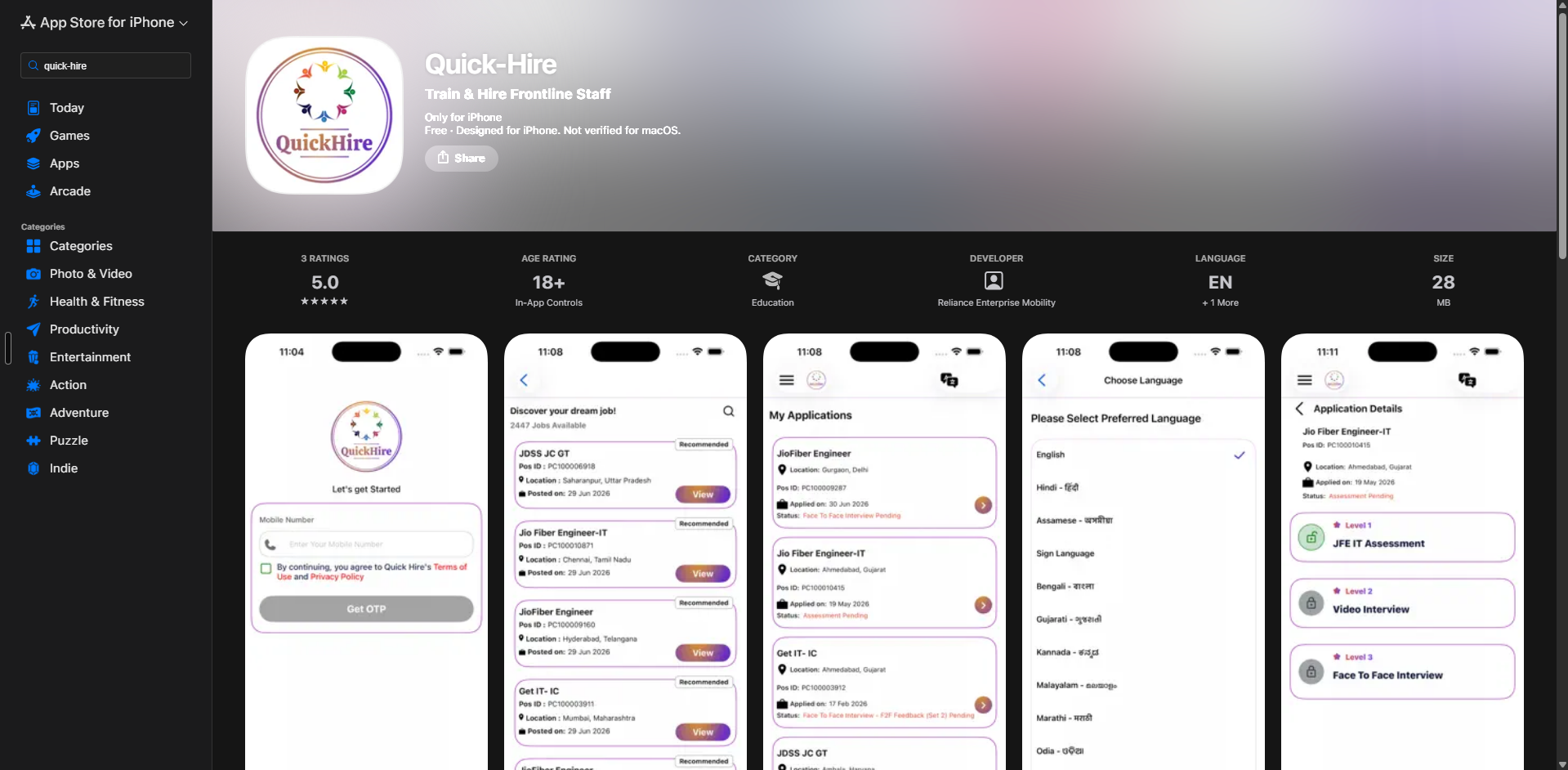
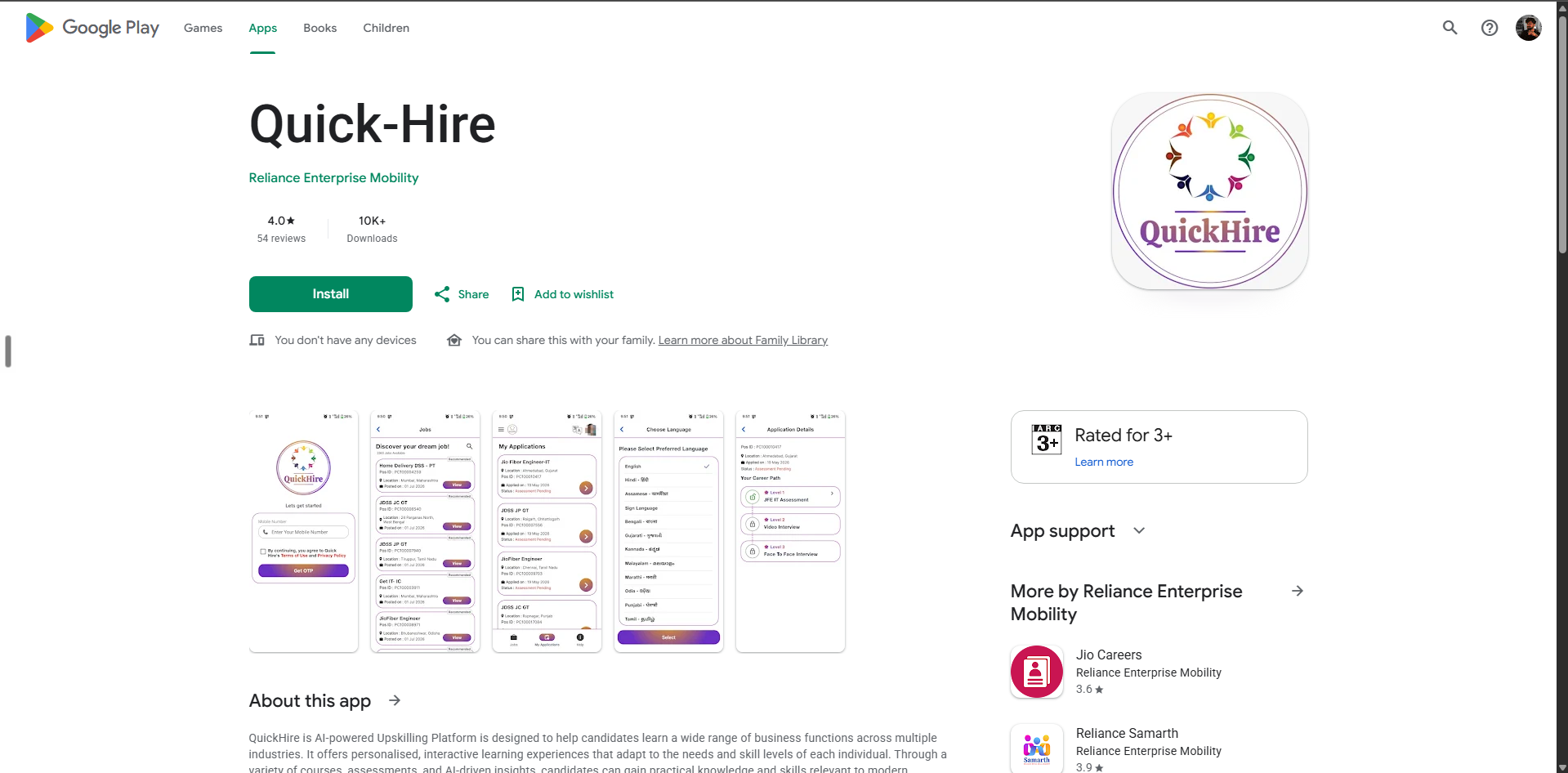
The Google Play capture shows 10K+ downloads, 54 reviews and a 4.0★ rating; the iPhone listing shows 3 ratings and 5.0★. These are store snapshots, separate from QuickHire’s 26.9K+ unique candidate workflow count.
Repeated emails, corrections and manual interventions showed me where the product was pushing effort onto Operations—and where cases were accumulating in the long tail.
Move recurring actions into self-service, bulk controls and system integrations. As volume grew, RTO → DOJ average turnaround improved from 9.2 to 5.5 days and its P90 reduced from roughly 21 to 12 days.
Duplicate job journeys were caused by how positions were modeled—not by how the cards looked.
Work with engineering to move candidate intake from position-based to role-based.
Support conversations told us what was noisy, but not necessarily where the funnel was slowing down.
Use operational data and status reconciliation to isolate stage-level delays. This showed the most measurable movement after approval: Approval → RTJ and RTO → DOJ.
Business, Operations, recruitment and technology often saw the same problem differently.
Translate requests into the underlying problem, surface edge cases, and work toward a solution that could survive production. Joining throughput increased while post-approval speed improved.
Multiple vacancies for the same role could create duplicate-looking candidate journeys and repeated evaluation.
I worked with the technology lead to challenge the position-first model and push candidate intake toward Job Role + Location, with specific position allocation happening later in the funnel.
Why it mattersThe solution required changing the underlying model—not redesigning the interface.
Hiring managers and teams repeatedly depended on central Operations for routine corrections and state changes.
I converted recurring operational requests into self-service actions, bulk controls and clearer system states across the February and July releases.
ExamplesExternal staff-allocation data was still travelling through recurring Excel uploads.
Worked with the teams involved to replace the manual file dependency with direct Better Place API synchronization.
QuickHire sits between senior HR leadership, national recruitment teams, Operations and engineering. Those groups often approach the same issue from different constraints.
My job is not to "win" those discussions. It is to make the trade-off visible, identify edge cases early and translate a business direction into something the system can actually support.
We did not begin with a mature product-analytics setup. For a period, production queries and manual reconciliation were the clearest signal of where the system was struggling.
Instrumentation should be designed before you need it.
Even after digitizing hiring, some critical processes still depended on Excel, email and central Ops.
Digitizing the interface does not mean you've digitized the system.
Several of the most important structural decisions came months after the product was already live.
0→1 proves something can exist. 1→10 proves it can survive.
My role sits between business intent, engineering reality and what Operations encounters every day.
A better interface cannot rescue the wrong state model.
Repeated workarounds reveal where the product is asking humans to compensate for it.
Stakeholder disagreement becomes productive when you can show a stronger model and its trade-offs.
Before launch, most decisions are hypotheses. After launch, the system starts telling you where you were wrong.
The portfolio story above focuses on my contribution. The full case study covers the hiring architecture, workflow changes, February and July releases, validation logic, operational visibility and upcoming platform work.
QuickHire connects workforce demand, candidate discovery, assessments, recruiter actions, hiring-manager decisions, approvals, position allocation and downstream onboarding. A state change in one part of the system can determine what several other users are allowed to do next.
| Signal | Observed movement | What it told us |
|---|---|---|
| Candidate scale | 26.9K+ unique candidates; peak monthly joins above 2.2K | The platform had moved beyond pilot conditions. |
| Monthly joining throughput | ~1.7K in Q1 → ~2.1K by Jul–Aug | Throughput increased by roughly 27%. |
| Approval → RTJ average | 3.95 days in Jul → 3.07 in Aug | Post-approval movement became about 22% faster. |
| Approval → RTJ median | 2 days in Jul–Aug → 1 day Sep MTD | The typical candidate was moving through the stage faster. |
| Approval → RTJ within 2 days | 51.0% in Jul → 62.9% in Aug → 72.4% Sep MTD | More candidates moved through the operational SLA window. |
| Same-day Approval → RTJ | 12.1% in Jul → 17.2% in Aug → 20.0% Sep MTD | The share completing the stage without a day of delay increased. |
| Approval → RTJ P90 | 8 days in Jul → 7 in Aug → 5 Sep MTD | The slowest cases improved, not only the average case. |
| HAS Generated → Approved | >90% within 2 days across Jul, Aug and Sep MTD; more than half approved same day | Approval responsiveness held while volume scaled. |
| RTO → DOJ average | 9.2 days in Dec → 5.5 in Aug | Downstream onboarding turnaround reduced by roughly 41%. |
| RTO → DOJ median | 5 days at launch → 4 days in Aug | Typical onboarding turnaround improved by 20%. |
| RTO → DOJ within 7 days | 67.3% in Dec → 78.5% in Aug | More candidates joined inside the first operational SLA window. |
| RTO → DOJ within 14 days | 84.2% in Dec → 94.8% in Aug | More candidates completed onboarding inside a predictable window. |
| RTO → DOJ P90 | ~21 days in Dec → ~12 in Aug | Long-tail onboarding delay reduced by approximately 45%. |
| Retention context | 30-day retention stayed in the high-80% range; 60-day retention reached ~80.5% for the Jul cohort after ~78.7% across Q2; 90-day retention did not consistently improve | These are observed downstream outcomes. The evidence supports workflow and onboarding impact, not a claim of long-term retention impact. |
Auto-Approval Rule Engine: Defining rules that allow standard cases meeting approved criteria to pass automatically while routing exceptions for manual review.
Background Verification: Bringing verification status and compliance visibility closer to the core hiring workflow.